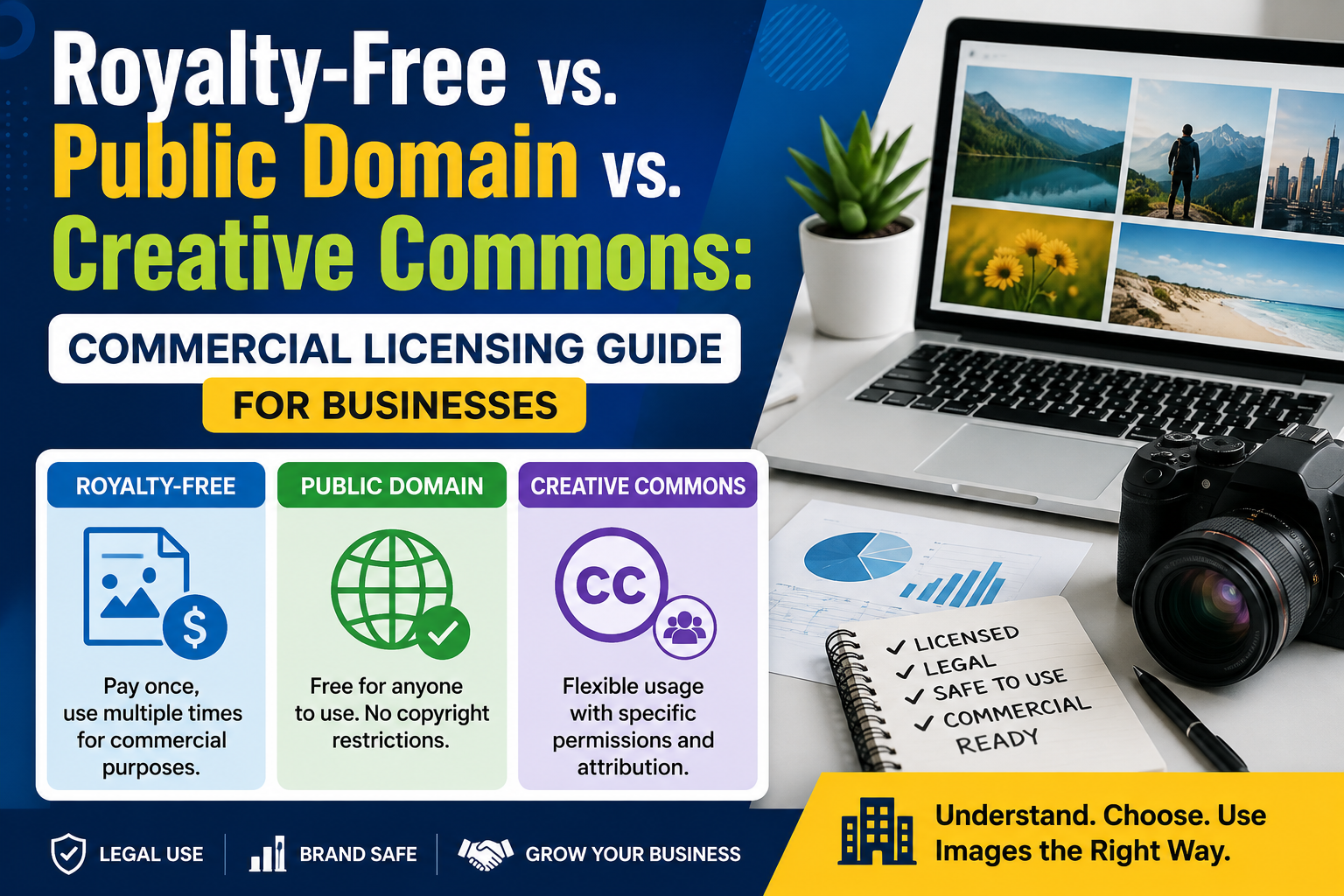
Royalty-Free vs. Public Domain vs. Creative Commons: The Ultimate Commercial Image Sourcing & Licensing Guide
In visual marketing and brand building, images drive engagement, conversion, and brand recall. However, behind every digital graphic, hero banner, billboard, and social post lies a complex web of intellectual property (IP) law.
For modern businesses, using an image without the proper legal clearance is not a minor oversight—it is a significant financial liability. Copyright holders, stock agencies, and automated legal scraping bots aggressively monitor digital spaces to issue copyright infringement notices, statutory damage claims, and cease-and-desist orders.
Understanding the distinctions between Royalty-Free, Public Domain, and Creative Commons is essential for protecting your organization from multi-million dollar legal claims. This comprehensive guide provides the legal mechanics, trademark nuances, release requirements, and compliance frameworks required to keep your business safe.
1. Fundamentals of Image Copyright Law for Businesses
The Automatic Nature of Copyright Protection Commercial Image Sourcing & Licensing Guide
Under international copyright agreements—such as the Berne Convention for the Protection of Literary and Artistic Works—copyright protection is automatic. The moment an artist, photographer, or designer creates a original visual work and fixes it in a tangible medium (whether on film or saved as a .RAW digital file), they automatically hold exclusive legal rights to it.
No formal registration with a government office (such as the U.S. Copyright Office) is required for copyright to exist, nor does the image require a visible copyright symbol ($\copyright$) or watermark.copyright infringement corporate risk
Visual Creation (Fixed in Tangible Medium)
  └─► Exclusive Intellectual Property Rights Granted Automatically
        ├─► Right to Reproduce
        ├─► Right to Distribute
        ├─► Right to Display Publicly
        └─► Right to Create Derivative Works
Direct vs. Secondary Infringement Risks Commercial Image Sourcing & Licensing Guide
When a company uses an unauthorized image across its marketing channels, it exposes itself to severe corporate liabilities:
- Direct Copyright Infringement: Occurs when a business copies, alters, or displays an image without explicit permission or a valid license from the copyright holder. Intent does not matter; “innocent infringement” is still legal infringement.
- Secondary (Vicarious/Contributory) Infringement: Occurs when an organization benefits financially from copyright infringement executed by employees, freelancers, or third-party agencies working on its behalf.
Legal Reality Check: Under statutory copyright frameworks (such as the U.S. Copyright Act, 17 U.S.C. § 504), willful copyright infringement can trigger damages up to $150,000 per infringed work, plus attorney fees and injunctions halting ad campaigns.
2. Deep Dive: The Three Primary Image Sourcing Frameworks Royalty-Free vs Public Domain
To navigate digital image sourcing safely, businesses must understand the three core visual asset licensing models.
                          IMAGE LICENSING FRAMEWORKS
                                      │
         ┌────────────────────────────┼────────────────────────────┐
         ▼                            ▼                            ▼
   ROYALTY-FREE                 PUBLIC DOMAIN               CREATIVE COMMONS
(Paid Paid/Commercial)       (No Rights Reserved)        (Conditional Licenses)
A. Royalty-Free (RF) Licensing
Legal Definition
Royalty-Free (RF) does not mean “free of cost.” It is a commercial licensing model where a buyer pays a one-time license fee to gain specified, non-exclusive rights to use the asset indefinitely across multiple channels without paying ongoing usage fees (“royalties”) per impression, click, or print run.
Standard vs. Extended/Enhanced Commercial Licenses Royalty-Free vs Public Domain
Most stock photography platforms (e.g., Adobe Stock, Getty Images, Shutterstock, iStock) split Royalty-Free licenses into two operational tiers:
| License Feature | Standard Royalty-Free License | Extended / Enhanced License |
| Print Run Limit | Typically capped at 500,000 copies | Unlimited physical print run |
| Resale Products | Prohibited (e.g., T-shirts, mugs, posters) | Permitted on items where image is core value |
| Digital Impressions | Often unlimited (web/social) | Unlimited + high-budget TV/broadcasting |
| Legal Indemnification | Standard limits ($10,000 – $25,000) | Enhanced limits ($250,000 – $1,000,000+) |
| Multi-Seat / Team Access | Single-user seat | Enterprise multi-seat access permitted |
Critical Sourcing Rules for Enterprise Teams
- No Transfers: Royalty-Free licenses are non-transferable. If a marketing agency purchases an RF asset under its own name, the client brand may not legally own the license unless bought explicitly on behalf of the client.
- No Standalone Distribution: You cannot resell or redistribute the raw image file as a downloadable asset or stock template.
B. Public Domain (PD)
Legal Definition Creative Commons commercial use
A visual asset resides in the Public Domain when it is no longer protected by copyright law. This occurs because:
- The copyright term has legally expired.
- The creator explicitly dedicated the work to the public domain worldwide (e.g., via CC0).
- The work was produced by an entity whose output is excluded from standard copyright protection (such as federal government employees acting within official duties under U.S. law).
Modern Expiration Timelines
Copyright expiration varies internationally: copyright infringement corporate risk
- Life of the Creator + 70 Years: Standard in the U.S., European Union, U.K., and Canada.
- 95 Years from Publication: Standard for corporate/works-for-hire published prior to certain legal updates.
       WORK CREATION
             │
             ▼
[Life of Author + 70 Years] ──► COPYRIGHT EXPIRES ──► PUBLIC DOMAIN TRANSITION
The Legal Catch for Commercial Brands Creative Commons commercial use
While a Public Domain image has zero copyright protection, it may still contain non-copyright legal encumbrances.
For example, a 19th-century public domain painting of a historical figure has no copyright owner, but a high-resolution digital photograph of that painting taken recently by a museum might be subject to contractual restrictions or database rights depending on jurisdiction. Furthermore, public domain photos depicting living individuals or corporate logos still present major privacy and trademark risks.
C. Creative Commons (CC) Licensing trademark risks in stock photos
Legal Definition
Creative Commons (CC) is a standardized non-profit licensing framework that allows creators to retain their underlying copyright while granting the public specific, conditional permissions to use their work without formal permission requests.
The 6 Core Creative Commons Licenses & Commercial Viability
                       CREATIVE COMMONS TAXONOMY
                                   │
      ┌────────────────────────────┴────────────────────────────┐
      ▼                                                         ▼
COMMERCIAL PERMITTED                                  NON-COMMERCIAL ONLY (Banned for Brands)
  ├─► CC BY (Attribution)                               ├─► CC BY-NC
  ├─► CC BY-SA (ShareAlike)                             ├─► CC BY-NC-SA
  └─► CC BY-ND (NoDerivatives)                          └─► CC BY-NC-ND
Below is the absolute compliance matrix for Creative Commons licenses in a commercial environment:
| CC License Type | Commercial Use Allowed? | Attribution Required? | Derivative Works Allowed? | Risk Level for Brands |
| CC0 (Public Domain) | YES | NO | YES | Low-Medium (Depends on Model Release) |
| CC BY | YES | YES (Strict) | YES | Medium (Requires legal compliance) |
| CC BY-SA | YES | YES | YES (Viral CC License) | HIGH RISK (Forces open source on derivatives) |
| CC BY-ND | YES | YES | NO | HIGH RISK (No cropping, overlays, edits) |
| CC BY-NC | PROHIBITED | YES | YES | FATAL (Lawsuit trigger for commercial brands) |
| CC BY-NC-SA | PROHIBITED | YES | YES | FATAL |
| CC BY-NC-ND | PROHIBITED | YES | NO | FATAL |
3. Hidden Commercial Pitfalls: Beyond Copyright model release legal guide
Copyright is only one-third of the legal clearance equation. An image can be completely copyright-free (e.g., CC0 or Public Domain) while still exposing your brand to catastrophic litigation under Right of Publicity, Right of Privacy, and Trademark Law.
                   TOTAL IMAGE CLEARANCE TRIANGLE
                                 /\
                                /  \
                               /    \
                              /  IP  \
                             / Copyright\
                            /------------\
                           /  Trademarks  \
                          / & Trade Dress  \
                         /------------------\
                        /  Model & Property  \
                       /      Releases        \
                      --------------------------
A. Model Releases and Publicity Rights
What is Right of Publicity? image licensing for businesses
The Right of Publicity prevents commercial entities from using an individual’s name, image, likeness, or voice to promote goods or services without explicit written authorization.
Crucial Insight: Free stock photo sites that upload “CC0” or “free commercial use” photos of recognizable people almost never secure verified, legally binding Model Releases from the subjects.
Commercial vs. Editorial Use Distinction
- Editorial Use: Using an image to illustrate news reporting, educational context, or non-promotional commentary. Model releases are generally not required under First Amendment/Freedom of Expression protections.
- Commercial Use: Using an image in ads, social media campaigns, brand websites, sponsored content, or promotional materials where a product or service is endorsed or sold. Model releases are strictly mandatory.
Model Release Audit Checklist
To be legally enforceable in court, a valid Model Release must contain:
- Clear identification of the photographer and the model.
- Unambiguous consent to use the subject’s likeness for commercial/promotional purposes worldwide in perpetuity.
- Proof of consideration (payment or exchange of value).
- Signature of a legal adult (or parent/guardian signature if the subject is under 18 years old).
B. Property Releases & Architectural Protections
Private Property and Restricted Locations
Just as individuals have privacy rights, owners of private property retain the right to restrict commercial photography on their premises.
- Private Locations: Interiors of private homes, private clubs, corporate offices, venues, and estates require a Property Release.
- Recognizable Landmarks: Certain world-famous structures are protected under trademark, copyright, or local design laws regarding commercial exploitation.
High-Risk Architectural & Property Examples:
- Eiffel Tower at Night: The nighttime light display of the Eiffel Tower is protected by artistic copyright under French law; commercial imagery requires explicit permission.
- The Sydney Opera House: Distinctive silhouette protected by registered trademarks.
- The Louvre Pyramid: Architectural design copyright protected.
C. Trademark & Trade Dress Infringement
Even if a photograph is published under a CC0 license, any logos, brand names, or distinctive product packaging within the frame remain active registered trademarks.
       CC0/Public Domain Image
                 │
                 ├── Recognized Corporate Logo Visible (e.g., Apple, Nike)
                 │         │
                 │         └──► TRADEMARK INFRINGEMENT RISK (False Endorsement Claim)
                 │
                 └── Recognized Product Design (e.g., Coca-Cola Contour Bottle)
                           │
                           └──► TRADE DRESS VIOLATION RISK
False Endorsement (Lanham Act § 43(a))
If your commercial advertisement features a model wearing a prominent corporate logo (e.g., a Nike Swoosh) or holding a recognizable branded product (e.g., an iPhone), the trademark owner can sue your company under the Lanham Act for False Endorsement—arguing that consumers will falsely believe the corporate giant endorsed your product.
4. Modern Frontiers: Generative AI Images & Legal Sourcing in 2026
The surge of AI image generators (e.g., Midjourney, DALL-E 3, Adobe Firefly, Stable Diffusion) has introduced novel copyright challenges.
                     GENERATIVE AI LEGAL LANDSCAPE (2026)
                                      │
         ┌────────────────────────────┴────────────────────────────┐
         ▼                                                         ▼
U.S. COPYRIGHT OFFICE POSITION                             COMMERCIAL AGENCY WARRANTIES
  └─► Purely AI-generated visuals                            └─► Enterprise platforms (Adobe, Getty)
      CANNOT be copyrighted (No Human Author).                   provide FULL INDEMNIFICATION against
      Cannot register exclusive ownership.                       AI training data infringement.
Key AI Copyright Developments
- Lack of Human Authorship: Courts and federal copyright offices maintain that images generated solely via text prompts lack human authorship and cannot hold copyright protection.
- Training Data Litigation: High-profile legal battles between copyright owners and AI developers emphasize the risks of using platforms trained on scraped copyrighted content.
- Enterprise AI Warranties: Commercial stock providers now offer AI generation tools backed by legal indemnification guarantees, assuring enterprise subscribers that the AI was trained exclusively on licensed stock libraries.
5. Enterprise Image Compliance Workflow & Risk Matrix
To eliminate copyright lawsuits, enterprise organizations must implement a strict, standardized asset clearance workflow.
                         ASSET CLEARANCE WORKFLOW
                                     │
                        Step 1: Check Copyright
                      (RF, PD, CC License Type?)
                                     │
                        Step 2: Inspect Likeness
                     (Recognizable People Present?)
                        ├── YES ──► Require Model Release
                        └── NO  ──► Proceed
                                     │
                        Step 3: Audit Trademarks
                   (Logos, Brands, Designs Visible?)
                        ├── YES ──► Blur/Remove or Retouch
                        └── NO  ──► Proceed
                                     │
                        Step 4: Archive Proof
                 (Store License File & Metadata)
The Master Risk Matrix for Commercial Visual Assets
| Asset Source | Copyright Risk | Trademark Risk | Publicity Risk | Action Required |
| Paid Stock (Standard RF) | VERY LOW | LOW | LOW | Store receipt and standard license document. |
| Paid Stock (Extended License) | VERY LOW | LOW | LOW | Mandatory for merchandise & high print runs. |
| Free Unsplash/Pexels/Pixabay | MEDIUM-HIGH | HIGH | EXTREMELY HIGH | Inspect for logos/faces. Avoid for primary ad campaigns. |
| Creative Commons (CC BY) | MEDIUM | HIGH | HIGH | Provide precise hyperlinked attribution. |
| Public Domain (Pre-1929) | LOW | MEDIUM | LOW | Audit for modern modifications or architectural rights. |
| AI Generated (Unindemnified) | HIGH | HIGH | HIGH | Use only for internal concepts, not brand trademarks. |
6. How to Provide Correct Attribution for Creative Commons (TASL Framework)
When using CC BY assets commercially, improper attribution constitutes a license breach, rendering your use an act of direct copyright infringement.
Always follow the TASL framework recommended by Creative Commons:
$$\text{TASL} = \mathbf{T}\text{itle} + \mathbf{A}\text{uthor} + \mathbf{S}\text{ource} + \mathbf{L}\text{icense}$$
Perfect Attribution Example
“Modern Office Collaboration” by Jane Doe is licensed under CC BY 4.0.
- Title: “Modern Office Collaboration” (Hyperlinked to original image page)
- Author: Jane Doe (Hyperlinked to author profile)
- Source: Provided via link to original platform
- License: CC BY 4.0 (Hyperlinked to official license deed)
7. Actionable Key Takeaways for Business Compliance
- “Free Download” Does Not Mean “Free Commercial Use”: Never assume an image found via search engine filters is cleared for commercial ads.
- Audit Models and Trademarks Independently: Copyright clearance does not equal model or trademark clearance.
- Avoid Non-Commercial (NC) and ShareAlike (SA) Licenses: Never use CC-NC or CC-SA images in marketing materials.
- Centralize Digital Asset Management (DAM): Store proof of purchase, license agreements, and metadata in a central corporate repository.