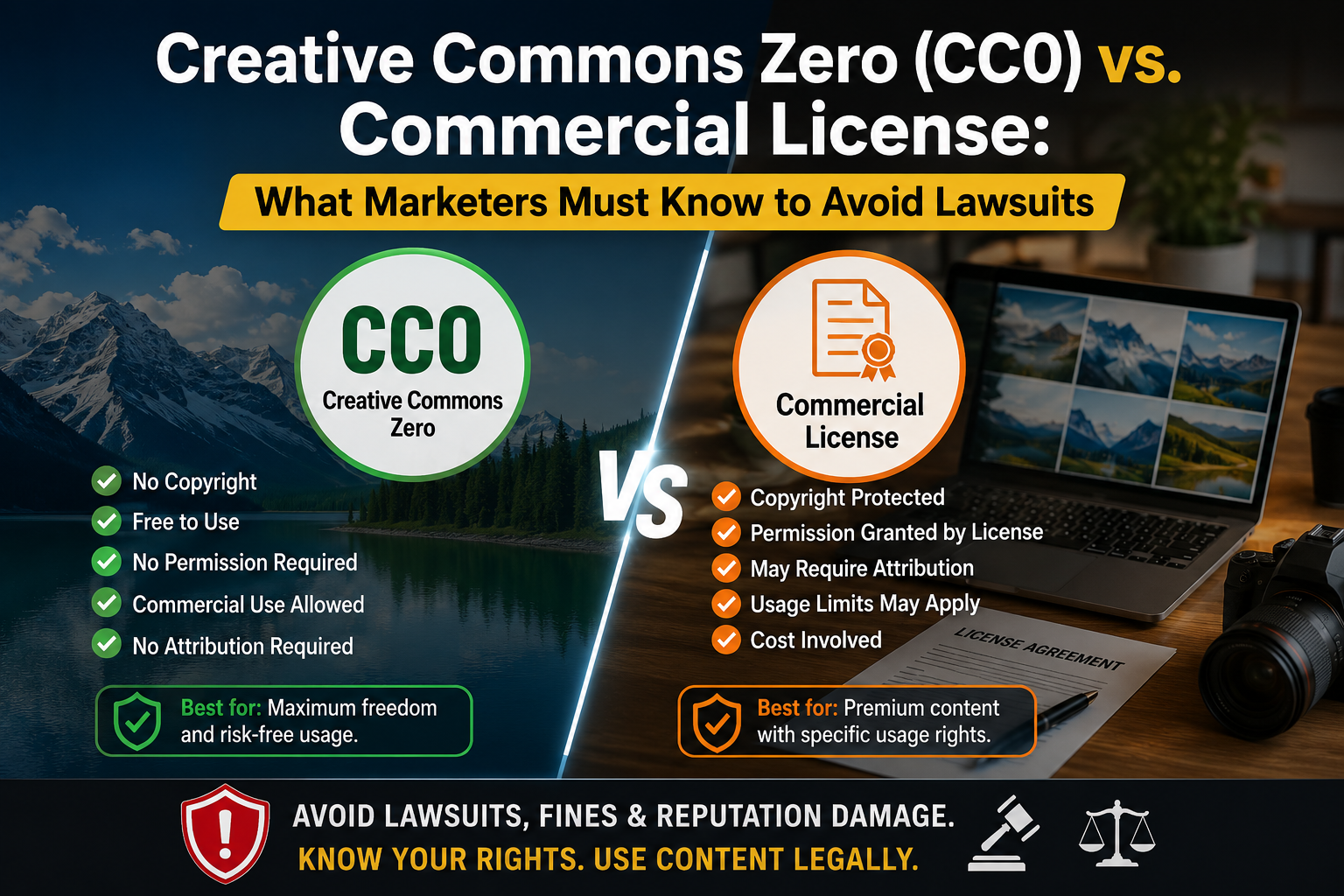
Creative Commons Zero (CC0) vs. Commercial License: What Marketers Must Know to Avoid Lawsuits

Quick Executive Summary: Evaluating cc0 vs commercial license options is a critical step for corporate marketing teams and digital agencies. While CC0 (Creative Commons Zero) waives copyright claims from the photographer, it provides zero legal protection regarding privacy rights, model release contracts, or trademarked property. To achieve reliable stock photo lawsuit prevention, agencies must rely on paid royalty-free commercial licenses that include verified model releases, property clearances, and financial indemnification guarantees.
The High-Stakes Legal Reality of Sourcing Marketing Visuals
In modern digital marketing, a single copyright infringement claim can instantly wipe out campaign ROI. Automated web crawlers and legal tech bots continuously scan corporate sites, landing pages, and social media ads to detect unlicensed media assets. Under U.S. copyright law, statutory damages for willful infringement can reach up to $150,000 per image, plus legal fee coverages.
Marketing leads, agency owners, and brand strategists often fall into the trap of using “free” online stock platforms. Understanding the core differences when evaluating a cc0 vs commercial license framework is the primary line of defense in corporate stock photo lawsuit prevention.
Copyright Free vs Royalty Free: Demystifying the Terminology
Before analyzing public domain waivers, marketers must clear up the confusion surrounding copyright free vs royalty free terminology—two phrases frequently misused across digital media communities:
- Copyright Free Assets: Truly copyright-free material means no party claims copyright ownership over the visual, typically because the work has entered the public domain or the rights holder has explicitly surrendered all copyright claims. However, completely copyright-free assets are exceedingly rare in commercial advertising.
- Royalty Free (RF) Licenses: Royalty-free does not mean free of cost. It represents a paid licensing model where a business pays a single, upfront fee or subscription cost to acquire commercial usage rights. Once licensed, the buyer can use the asset in multiple campaigns without paying ongoing royalties per impression or sale.
Legal Warning: Never assume an image found via search engines is “copyright-free” simply because it lacks a visible watermark or copyright notice. Copyright protection attaches automatically the moment an image is created.
CC0 vs Commercial License: The Critical Legal Breakdown
To establish strong organizational policy for stock photo lawsuit prevention, corporate legal teams must evaluate how a cc0 vs commercial license operates under contract and intellectual property law:
Creative Commons Zero (CC0) Waiver
Creative Commons Zero is a legal instrument that enables creators to surrender their copyright interests globally, placing their work as close to the public domain as legally permitted. When downloading a CC0 image, the photographer agrees not to sue you for copyright infringement. However, CC0 only waives copyright—it offers zero warranties or legal protections for third-party rights, privacy releases, trademark compliance, or portrait permissions.
Standard Commercial License
A paid commercial license granted by an established stock asset platform is a legal contract. It provides explicitly defined commercial usage rights and includes contractual guarantees that the image does not violate third-party intellectual property or privacy laws. Premium commercial licenses frequently include corporate legal indemnification, meaning the stock agency pays all legal defense costs and damages if the licensed visual triggers an unexpected lawsuit.
| Comparison Feature | Creative Commons Zero (CC0) | Standard Commercial License |
|---|---|---|
| Upfront Cost | Free ($0) | Paid (One-time fee or subscription) |
| Copyright Waiver | Yes (Photographer waives copyright) | No (Licensor grants explicit usage rights) |
| Model Releases Included? | No (Extremely high legal risk) | Yes (Verified, legally binding releases) |
| Property Releases Included? | No (No protection for brands/logos) | Yes (Clearance for private architecture/logos) |
| Legal Indemnification | None ($0 coverage) | Included ($10,000 to $1,000,000+ policy) |
| Lawsuit Risk Level | High Risk for corporate campaigns | Very Low Risk (Audit-proof protection) |
The Invisible Trap: Model Releases vs. Property Releases
The single biggest reason free CC0 photos trigger legal action against corporate brands is the absence of third-party rights releases. A photographer uploading a photo to a CC0 platform can only waive their own copyright; they cannot waive the individual privacy rights of people in the photo or the trademark rights of property owners.
1. Model Releases (Right of Publicity & Privacy)
When a recognizable person appears in a photo used for commercial marketing, advertising, or promotional landing pages, that individual must sign a legally binding Model Release Form. This contract grants permission for their likeness to be used commercially.
If your agency uses a free CC0 photo featuring a person without a signed model release, that individual can sue your company for violating their Right of Publicity. The fact that the photographer uploaded the photo under CC0 is completely irrelevant in a right of publicity court case.
2. Property Releases (Trademarks, Architecture & Logos)
Commercial photography also requires Property Releases when private property, protected architectural designs, or proprietary trademarks are prominently depicted. Examples include:
- Recognizable corporate logos on clothing, footwear, or electronics.
- Ticketed private locations, stadium interiors, or distinctive luxury real estate.
- Protected modern architectural works (e.g., specific lit light displays on famous towers).
Using a CC0 asset that contains an unreleased trademark or property element in an ad campaign exposes your agency to direct trademark infringement and unfair competition claims.
Real-World Case Scenarios: How “Free” Images Trigger Statutory Damages
To understand effective stock photo lawsuit prevention, agency owners must review how CC0 sourcing vulnerabilities play out in commercial contexts:
Scenario A: The Unauthorized Upload Strategy
An individual user grabs a copyrighted photo from a professional studio’s website and illegally re-uploads it to a free CC0 stock repository. An ad agency downloads the asset believing it is safe and features it in a national marketing campaign. Months later, the original copyright-holding photographer discovers the usage and issues a demand letter. Because the user who uploaded the photo had no legal right to waive the copyright, the CC0 status is void, and the agency remains strictly liable for full copyright infringement damages.
Scenario B: The Non-Commercial CC License Trap
A marketer downloads a Creative Commons visual tagged under a CC BY-NC (Attribution-NonCommercial) agreement, misunderstanding the precise boundary between non-commercial and commercial activity. The image is published on a corporate blog that indirectly promotes a SaaS platform. Legal teams representing the creator flag the usage as monetized brand promotion. Because the license strictly forbade commercial exploitation, the agency faces immediate licensing fee demands and threat of federal litigation.
Stock Photo Lawsuit Prevention: Agency Compliance & Sourcing Checklist
Implement this standard operating procedure across your design, content, and media buying teams to guarantee complete legal safety when sourcing visual media:
- Prohibit Unverified CC0 Sourcing for Client Campaigns: Ban the use of raw, unverified CC0 images in paid advertising, product packaging, and core website infrastructure.
- Maintain Centralized Asset License Records: For every visual asset deployed, store the digital purchase receipt, licensing terms, and proof of license ID in an enterprise Digital Asset Management (DAM) system.
- Verify Model & Property Release Documentation: Confirm that the stock license explicitly confirms signed model releases for every recognizable person and property releases for private locations.
- Audit Existing Marketing Assets: Conduct periodic internal audits using reverse image lookup tools to verify that historical blog posts and ad creatives rely on legitimate commercial licenses.
- Partner with Reputable, Indemnified Stock Providers: Source commercial assets exclusively through platforms that supply contractually binding indemnification policies against copyright and privacy claims.
Secure Your Brand with Commercially Verified Assets
Avoid statutory damages, model liability risks, and licensing disputes. Source fully cleared, high-resolution stock visuals backed by transparent commercial terms.
Explore Safe Commercial Stock Assets